Looking Past the Information Smoothie with Media and Digital Literacy
Bonni Stachowiak9 min read
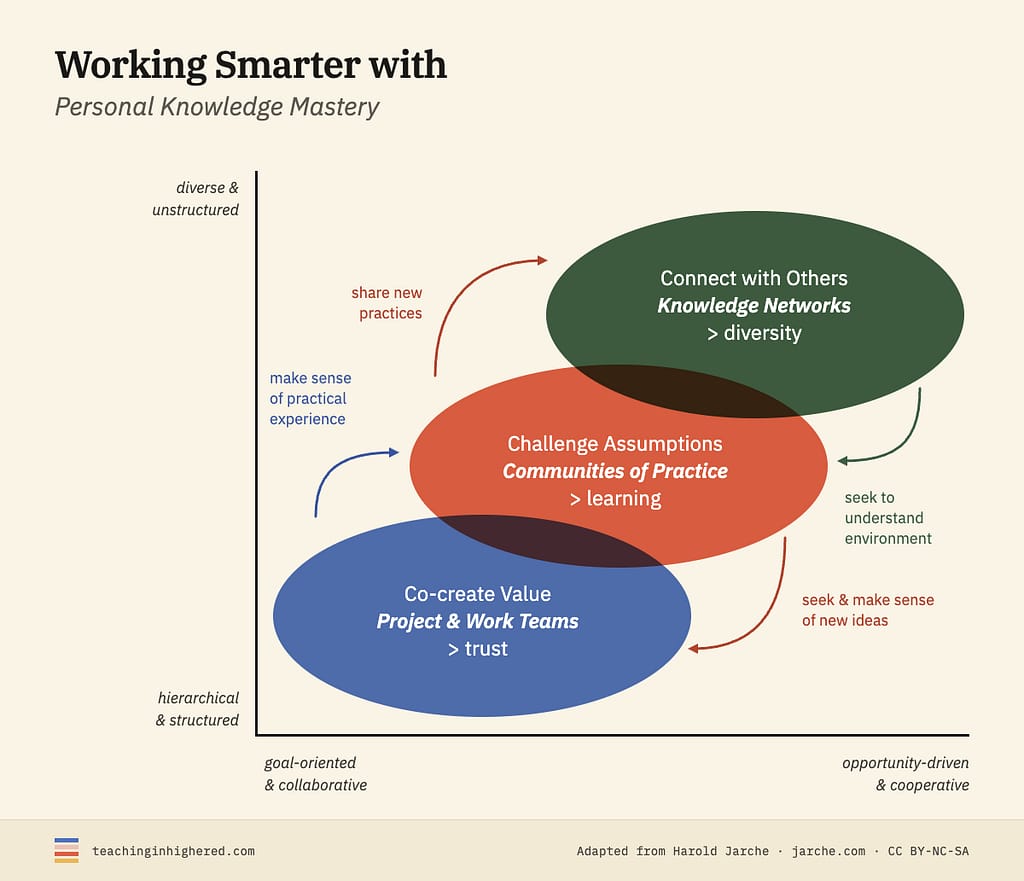
The first time I went through the personal knowledge mastery workshop with Harold Jarche, I was presented with one very familiar framework (Mike Caulfield’s SIFT method) and one that was new to me (Marshall McLuhan’s tetradic Laws of Media). Before Harold introduces these lenses, he stresses the importance of critical thinking and reminds us how essential sharing is in the sense-making process. He writes:
A PKM process can help to develop critical thinking skills, where sense-making includes observing, studying, challenging (especially one’s assumptions), and evaluating. Developing these skills takes practice, appropriate feedback and an environment that supports critical thinking.
Find and master tools that allow you to observe and study your field, participate in conversations that push your understanding, challenge your assumptions, evaluate others’ arguments, and make tentative opinions that in turn will be challenged. The key is to be engaged in your learning and in your profession and web tools are all about connecting.
In terms of growing our capacity for critical thinking in our PKM practices, Harold identifies three primary components: observing, forming tentative opinions (what Harold calls “half-baked ideas“), and continually evaluating ideas, with the courage to challenge them even when they are our own.
What Mike Caulfield has been building
I have had Mike Caulfield, the creator of the SIFT framework, on the podcast a handful of times over more than a decade. While there are many ways in which his work remains consistent, there are also ways in which the changing landscape of media and continued emergence of artificial intelligence have drastically changed things. In the first conversation we had, he stressed how vital domain knowledge is to digital literacy. Mike wrote in 2016:
In reality, most literacies are heavily domain-dependent, and based not on skills, but on a body of knowledge that comes from mindful immersion in a context.
In the book he co-wrote with Sam Wineburg, Verified: How to Think Straight, Get Duped Less, and Make Better Decisions About What to Believe Online, Mike continues to help us think more critically and become more credible sources for the people around us. They stress that we can get quick signals to determine if we even know what it is that we’re looking at and to shift to reading laterally to find better coverage. One message Mike advocates for throughout all his work is for us to remember why we are looking into something in the first place.
Mike wants us to be people others take seriously, something I thanked him for in episode 492, since it helped me see how much that framing matters to students. If we aren’t sure something is what we think it is, sometimes it just isn’t important enough to fact-check, so we move on with our day (without reposting it, I should add). Mike and Sam touch on AI in a small portion of the book, but things have continued to evolve since it was published. As I have continued to follow Mike’s work and sense-making, how he has been wrestling with AI has been fascinating to me. Here are three projects Mike has written about in his newsletter and on his video channel since Verified came out.
Deep Background
One way Mike wrestled with what AI can and cannot do for fact checking was to create Deep Background, a custom GPT (or prompt you can paste into your preferred LLM). He says it eats up a ton of tokens, but because it draws on Toulmin argumentation theory, it can give most of us a better shot at getting to accuracy than we would ever manage on our own. He wrote a piece about what he believed people were asking for, when they kept inquiring what SIFT for AI looks like, which will give you a good sense of Deep Background and its capabilities. Here’s how Mike describes it:
Others have called this a fact-checking prompt; I see it as a “contextualization prompt.” The model searches for conflicting sources, categorizes evidence through a Toulmin framework, and produces structured reports with verified facts, corrections, and source assessments. The approach models a research assistant suitable for students, one that aids investigation while leaving conclusions to the researcher.
plot.fyi
About a year after he started writing about Deep Background, Mike came out with a movie exploration tool he calls plot.fyi. There are two characteristics of this resource that make it unique. One is the way that he has been able to classify movies. We’re in a whole different league than trying to find a movie to watch on a Friday night, based on whether you’re in the mood for a romantic comedy or an action movie. Instead, using help from AI, Mike has been able to identify over 1,300 style and plot attributes that make connections that would not be possible through the regular classification systems.
The second is that when you visit plot.fyi, you won’t be greeted by an AI chatbot. Instead, you type in the name of a film and plot.fyi returns good matches from its database of half a million tags across 22,000 movies. Mike explains more about plot.fyi:
A tool to explore intersections between characteristics of films — not only finding very similar films but sometimes very dissimilar ones that share surprising elements. Co-anchor two or three films to surface what they have in common; drill into any pairing to see exactly which tags drive the match. Not a recommendation engine: It’s up to you to decide what to do with the films it surfaces.
Mike’s plot.fyi doesn’t eat up tokens when the masses go to this site to find their next movie. Instead, the AI use comes in the applying of the tags and identifying those now-surfaceable commonalities. In Tilling the Garden: A different way to use AI to make interesting and useful apps, Mike explores this in much more depth than I’m going into here.
A bit beyond that, he wrote Four Tips for Better Prompting, in which he introduces one of my favorite metaphors I’ve heard in a long while (and I hear a lot of metaphors, friends): the information smoothie. Mike uses it to describe what happens when an LLM responds to a user’s question by taking a bunch of different sources and “blending them all up into a sort of milkshake.” The resulting response can sound credible and is chock-full of opinions. But it can be lacking in sources and can get things wrong. The custom prompts Mike has been working on, and projects like plot.fyi that do the AI analysis before the data ever reaches us, are his ways of working around those limits and using AI where it does its best work.
Parallel Days News Browser
In a subtitle that made me chuckle, Mike declares: “Because what I needed was yet another tagging project.” I guess instead of helping us watch movies better geared toward our interests, he wanted to have us be more informed. He describes how he had an idea for providing more context between different modern-day U.S. presidents where you could see a day from one president and see that same (or similar) day in comparison with a different president.
Visit Parallel Days and you’ll be able to see a random day, the present day, or another of your choosing. You can view the most controversial stories from that day, or even search on an issue or for an event. He says it would be easy for him to share what he sees when he pulls a day and views it next to another presidency, but he encourages us to explore it for ourselves and draw our own conclusions.
Mike has said he will write more about Parallel Days. It has been fun to catch glimpses via his newsletter and on social media. What I’m most intrigued by is the method he used to make the data and analysis auditable, as that’s an element he has continued to stress as vital when working alongside an AI tool in creating resources like this.
Nothing New Under the Sun
I mentioned up top that the first time I took the personal knowledge mastery workshop I was pleased to see some material that was already familiar to me. However, in the case of McLuhan’s Media Tetrad, I was starting from scratch in my learning. I share what it is and my example tetrad in last year’s PKM workshop post: Can You Keep a Secret?
Here’s how I described the tetrad then:
It starts with a new medium.
McLuhan posits through his Laws of Media that every new medium results in four effects. Jarche explains that under McLuhan’s laws, each new medium:
Extends a human property,
Obsolesces the previous medium (& makes it a luxury good)
Retrieves a much older medium &
Reverses its properties when pushed to its limitsWhen we take time to understand what happens with new media, we can put in place steps to negate or minimize the negative effects. Ample examples exist of ways that social media extends humans’ voices, while ultimately making healthy, human-to-human conversation obsolete. Then, our more tribal affiliations can kick in (Twitter, anyone?) and we reverse into “populism and demagoguery,” according to Jarche’s example.
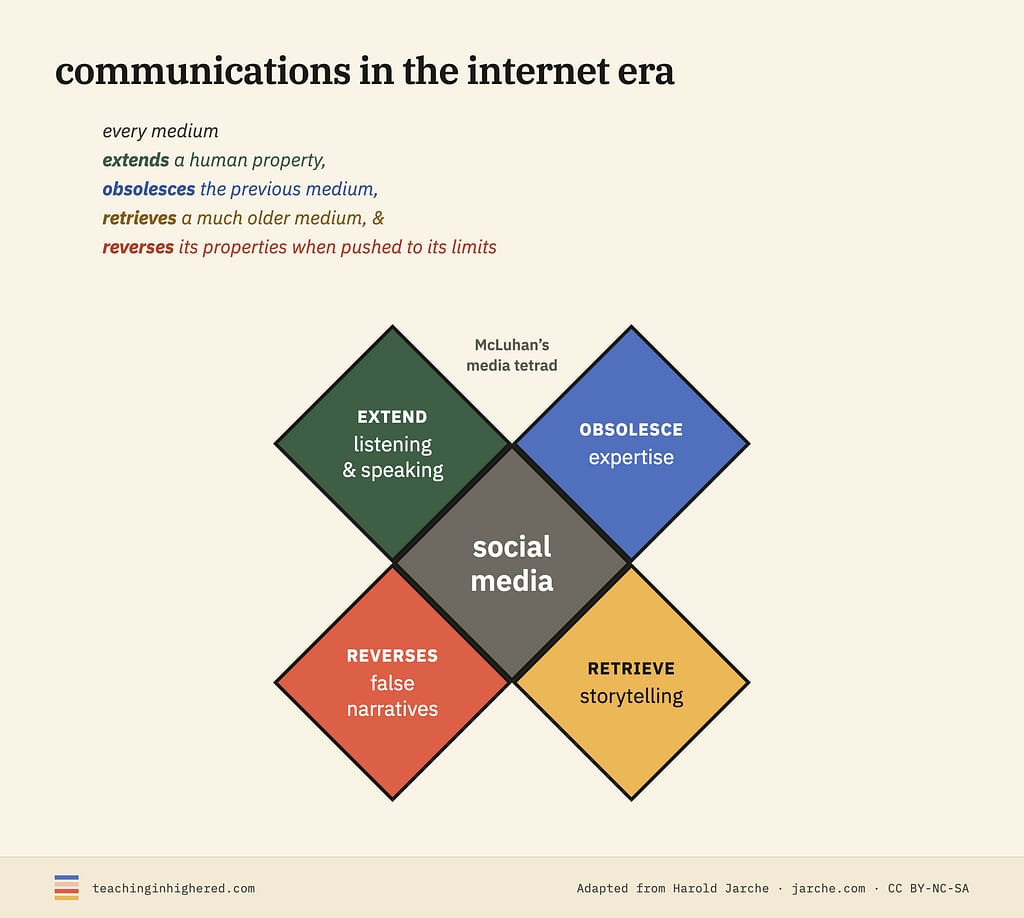
With the continued emergence of generative and other forms of AI, I still find McLuhan’s media tetrad a helpful lens for analysis. I do wish that more people would define their terms when critiquing or praising AI, so we would all have a better sense of what was being discussed or debated.
Taken Seriously
I rarely meet a person who isn’t interested in being taken seriously, or at least seen as credible in their areas of expertise, whatever they might be. The media we come across can help us become more knowledgeable about a topic or gain skills we value. It can also lead us astray or, even worse, use our reposts to amplify false information.
That’s part of why I wish more of us would define our terms when we talk about AI. Here is a half-baked tetrad for one kind of AI, the chatbot that answers our questions. It extends our reach across many sources at once. It obsolesces scanning a page of search results. It retrieves something much older: asking a person with domain expertise and trusting their answer. Pushed to its limits, it reverses into an information smoothie, an answer that sounds credible but no longer shows where its ingredients came from (it might taste pretty gross, too).
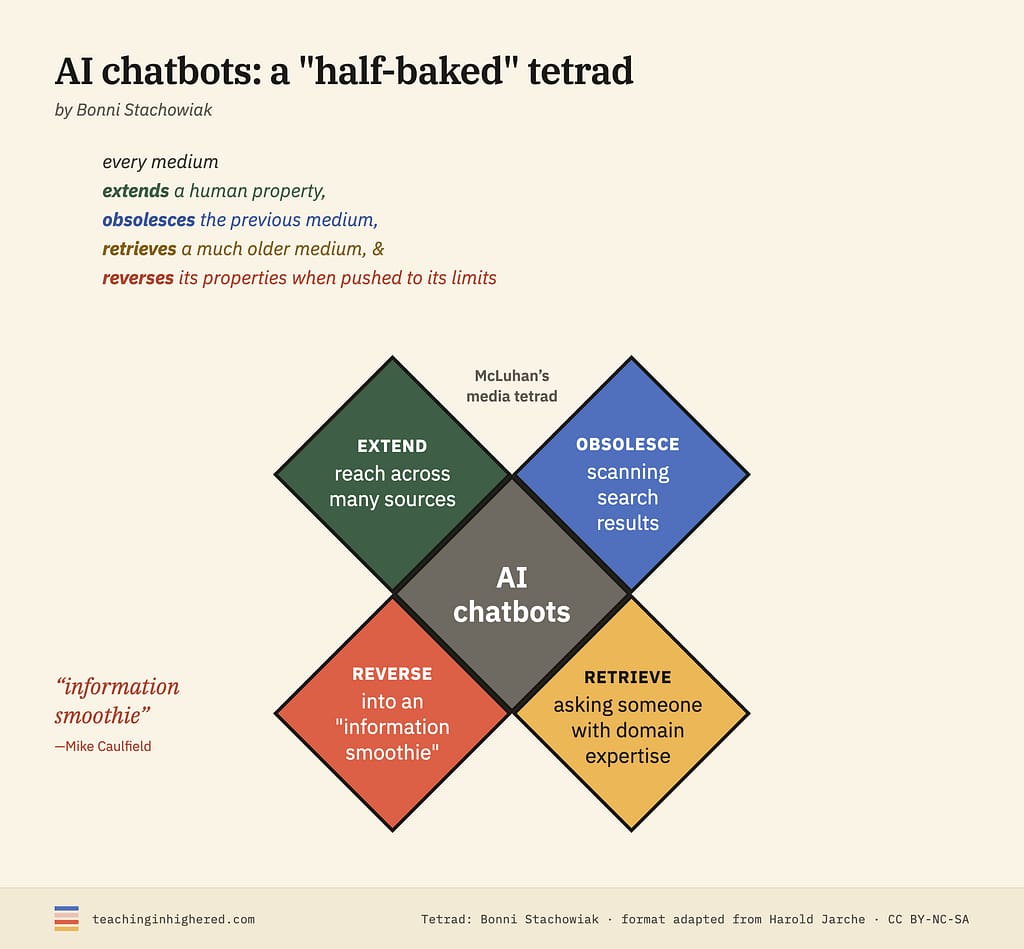
Mike’s projects would produce different tetrads, since they use AI in different ways (often before the user comes in and makes a query). Deep Background keeps the chatbot but makes it show its sources and use a sophisticated argumentation theory to present and analyze evidence. plot.fyi and Parallel Days do the AI work before anyone ever hops on the pages to look for information, so what reaches us are the results based on sophisticated tagging Mike audits along the way. I’m glad we can learn from experiments like the ones Mike Caulfield has been working on these past couple of years, and also reach much further back for a lens like the McLuhans’ tetrad.
Image Credits
Featured image photo by Matthew Buchanan on Unsplash
“Communications in the internet era” tetrad adapted from Harold Jarche, CC BY-NC-SA 4.0
“AI chatbots: a half-baked tetrad” by Bonni Stachowiak, format adapted from Harold Jarche, CC BY-NC-SA 4.0